
 English
  日本語
日本語  Français
  Español
  عربى
عربى  italiano

Industry News
 May 18, 2026
 Posted by Administrator
Luxury Food Gift Packaging: Materials, Structure & Design
Content
- 1 Why Packaging Is the First Impression in Luxury Food Gifting
- 2 Materials That Define a Luxury Feel
- 3 Structural Choices That Elevate the Unboxing Experience
- 4 Finishing Techniques That Signal Premium Quality
- 5 Seasonal and Festival Gifting: Tailoring Packaging to the Occasion
- 6 How to Brief a Luxury Food Packaging Supplier
Why Packaging Is the First Impression in Luxury Food Gifting
In luxury food gifting, the box is never just a container. Before a recipient tastes a single piece of chocolate, unwraps a zongzi, or opens a tin of specialty tea, the packaging has already communicated everything about the perceived value of the gift. A box that feels heavy in the hand, opens with resistance, and reveals a carefully arranged interior creates an emotional response that the product alone cannot generate. One that flexes, catches on itself, or arrives with a torn corner does the opposite — regardless of what is inside.
This dynamic has intensified as gifting has become increasingly social. Unboxing moments shared online mean that luxury food packaging now performs in two contexts simultaneously: in the hands of the recipient and on screen for an audience. Brands and corporate gifting teams that understand this invest in packaging that photographs as well as it feels. The structural integrity, the finish, the color depth, and the way a lid lifts all become part of the product story.
The commercial case is equally clear. Research across premium food categories consistently shows that consumers ascribe higher quality to the contents of well-packaged products — even before tasting. For mid-tier food products positioned as premium gifts, the right packaging does not just present the product; it justifies the price point.
Materials That Define a Luxury Feel
The foundation of any luxury food gift box is the board underneath the surface. Rigid greyboard — typically ranging from 1,200gsm to 2,000gsm depending on box size and structural requirements — provides the weight and solidity that consumers instinctively associate with quality. When you pick up a rigid box and it does not flex, when closing the lid produces a soft, definitive sound rather than a rattle, that sensation is delivered by the board choice.
Over the greyboard, the wrapping paper or laminated art paper determines the surface character of the box. Options range from textured laid papers that mimic handmade materials, to coated papers suited for high-resolution printing, to specialty materials including fabric-effect papers, metallic grounds, and embossed textures. For luxury food gifting specifically, papers with a tactile quality — soft-touch coated stocks, linen-grain textures, or velvet finishes — signal care and craftsmanship before the box is even opened.
Internal materials matter equally. Foam inserts, molded pulp trays, vacuum-formed plastic liners, and hand-assembled paper card dividers all serve the functional purpose of holding food products securely in position. For luxury applications, the choice between these options also carries aesthetic weight: a satin ribbon lift-tab over a foam base communicates differently than a plain cardboard tray, even if both hold the product identically.
Structural Choices That Elevate the Unboxing Experience
The structure of a luxury food gift box determines how the unboxing moment unfolds — and that sequence matters. Different box formats create different emotional arcs for the recipient.
Lift-lid rigid boxes are the classic format: a base and a separate lid that slides off to reveal the contents in a single motion. Simple, clean, and well-suited to food arrays like chocolates, mooncakes, or tea collections where the top-down reveal is the moment. The lid-to-base fit is critical — too loose and the box feels cheap; too tight and it frustrates the recipient. A well-calibrated fit, typically 2–3mm of resistance, creates the satisfying resistance that premium packaging buyers specify explicitly.
Magnetic closure boxes add an interactive element. A hinged lid held shut by embedded magnets creates a deliberate opening sequence that slows the experience down and adds ceremony. For gifting occasions where the act of presenting and opening is itself part of the ritual — festival gifts, corporate presentations, wedding favors — this format reinforces the occasion without requiring additional messaging.
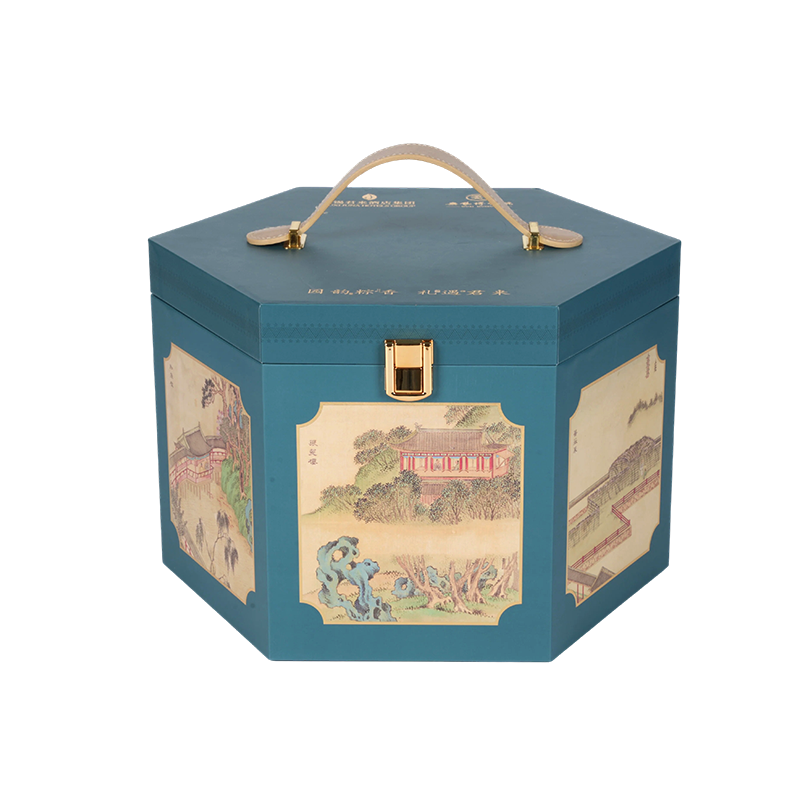
Drawer-style boxes, where the inner tray slides out from a sleeve, work particularly well for multi-compartment food gifts. The layered reveal — sleeve, then tray, then contents — adds depth to the unboxing experience and creates natural opportunities for interior printing that the recipient discovers progressively. For hexagonal or other geometric formats, the drawer mechanism also provides an engineering solution that maintains the visual integrity of the outer shape while allowing practical access.
Finishing Techniques That Signal Premium Quality
Once the structural and material decisions are made, finishing techniques determine how the surface of the box reads at close range — in retail, on a gift table, or in a photograph. The combination of base lamination and decorative treatments creates the visual and tactile layering that defines high-end packaging.
The base lamination choice sets the tone. Matte lamination absorbs light, deepens colors, and produces a quiet, understated elegance — the dominant choice for luxury food packaging targeting sophisticated adult audiences. Gloss lamination intensifies color saturation and creates vibrancy, better suited to festive or children's gifting contexts. Soft-touch lamination, which produces a velvety resistance to the finger, adds a tactile premium that photographs cannot convey but recipients immediately notice and respond to.
On top of the base laminate, decorative treatments add differentiation:
- Hot foil stamping applies metallic or holographic foil to selected areas under heat and pressure, producing a reflective quality that catches light. Gold and silver remain the dominant choices for food gifting; rose gold has grown significantly in premium confectionery and tea packaging.
- Embossing and debossing create raised or recessed areas in the surface, adding a three-dimensional quality to logos, borders, or pattern elements. Blind embossing — without ink or foil — produces a subtle, tone-on-tone effect that reads as confident restraint.
- Spot UV coating applies a high-gloss varnish to selected areas over a matte ground, creating contrast between treated and untreated surfaces. The effect draws the eye precisely to the elements the designer wants to emphasize — a logo, a pattern motif, or a key brand element.
For luxury food gift packaging, the most effective approaches combine a restrained base finish with one or two decorative treatments applied with precision, rather than layering every available technique onto a single surface.
Seasonal and Festival Gifting: Tailoring Packaging to the Occasion
Luxury food gift packaging performs differently across seasonal and cultural contexts, and the most effective packaging programs build in flexibility for occasion-specific adaptation without requiring a complete redesign each cycle.
Chinese traditional festivals — Dragon Boat Festival, Mid-Autumn Festival, Lunar New Year — each carry distinct visual vocabularies, color associations, and product categories. Dragon Boat Festival zongzi gifting, for example, has evolved from functional food packaging into a premium gifting category where the box frequently outlasts its contents as a decorative object. Packaging designed for this occasion benefits from structural durability, culturally resonant aesthetics, and internal organization that presents multiple zongzi varieties in a clearly differentiated way. Festive food gift packaging solutions that can adapt across multiple seasonal events through interchangeable sleeve designs or modular interior configurations offer the best return on tooling investment for brands with multiple annual gifting windows.
Western seasonal gifting — Christmas, Valentine's Day, Easter — operates on different visual registers but shares the same underlying dynamic: packaging that feels occasion-appropriate amplifies the perceived thoughtfulness of the gift. For food brands entering corporate gifting programs, a base box structure that accommodates a seasonally themed outer sleeve allows a single production run to serve multiple calendar events.
How to Brief a Luxury Food Packaging Supplier
The quality of the output from a luxury food packaging supplier is directly proportional to the quality of the brief they receive. Vague requests — "something premium," "high-end feel," "luxury look" — produce generic responses. Specific briefs produce specific solutions.
A productive supplier brief for luxury food gift packaging covers the following:
- Product dimensions and weight: The exact dimensions of the food items to be packaged, including any secondary packaging (individual wrappers, tins, pouches), and the total filled weight of the box. These determine board grade, insert design, and structural requirements.
- End-use context: Retail shelf, corporate gifting, e-commerce delivery, or in-person presentation each impose different structural requirements. A box designed for shelf display does not need to survive courier transit without additional outer packaging; one designed for e-commerce must.
- Quantity and timeline: Minimum order quantities for rigid gift boxes typically begin at 500–1,000 units for standard formats. Custom tooling for non-standard shapes — hexagonal boxes, geometric forms — usually requires higher minimums to amortize the die-cutting cost. Sampling cycles add 3–4 weeks before production; factor this into seasonal launch timelines.
- Regulatory requirements: Food-contact materials require compliance documentation. If any internal component — insert, tray, liner — will directly contact the food product, confirm food-grade certification with the supplier before production begins.
Suppliers who ask these questions before quoting are demonstrating the kind of technical engagement that luxury food packaging actually requires. Those who quote immediately from a sketch deserve proportionate scepticism. Custom gift wrapping options developed through a structured brief process consistently outperform those produced reactively.
Product Categories
Mainly engaged in various types of packaging boxes made of different materials and various paper products.


-
Email
[email protected]Phone Number
+86-15300896380 -
Address
No. 58 Hongmudan Road, Songjiang District, Shanghai, China -
Quick Links
Home About Us Service Industries News Contact -
Products
Food Packaging Cosmetic Packaging Gift Wrapping Apparel Packaging Home Textile Packaging Other Packaging Paper Packaging Boxes -
feel free to contact us

