
 English
 日本語
 Français
 Español
 عربى
 italiano


Industry News
 Oct 26, 2026
 Posted by Administrator
Die Cutting Operation Explained: Tolerances, Tooling Costs and Press Choice
A buyer signs off on a folding carton proof in March, and six weeks later 40,000 flat blanks arrive with creases that crack open along the fold. Nothing was wrong with the artwork. The die cutting operation had been quoted on price per thousand and on nothing else.
Conclusion first: a die cutting operation is a press process in its own right, and it is judged on three numbers — crease geometry against board caliper, print-to-cut registration, and make-ready time per die. Tonnage and press brand tell you almost nothing about whether a carton will fold cleanly at 40,000 units.
What follows breaks the operation into its physical parts, compares the three production routes on cost and tolerance, shows where the hidden money sits, and sets out a qualification path you can run before the first die is ordered.
Content
What Actually Happens Inside a Die Cutting Operation
A steel rule die is a plywood base with razor-edged rules bent into the outline of your flat blank. Cutting rules slice through the board; creasing rules, set slightly lower and blunter, compress it so the fold hinges instead of tearing. The die sits in a platen press, and a counter plate underneath carries a matrix that matches every crease line. Pressure, not speed, is the variable that matters.
Cut versus crease
Cutting rules penetrate the board fully. Creasing rules stop short. A crease that is too deep cracks the coating; too shallow and the fold wanders off the line during gluing.
Make-ready
Packing tape and paper shims are layered under the counter plate to even out pressure across the sheet. This step is where a 30-minute job quietly becomes a 90-minute job.
Nicks and stripping
Tiny nicks hold each blank in the sheet through the press. Waste is then stripped by hand or by a stripping station, and nicks that are too strong tear the board on break-out.
Registration
Print-to-cut alignment is set from the gripper edge. On laminated litho board, ±0.3 mm is realistic; on uncoated kraft, ±0.5 mm is a fair expectation.
Speed is rarely the constraint. A flatbed platen running 250–400 gsm folding carton will cycle 3,000 to 5,000 sheets an hour once settled, but the first few hundred sheets belong to the make-ready, not to your order. Shapes with laser-cut windows follow the same logic on a different machine — the aperture is a die cut with a different tool.
 Iridescent Die-Cut Skincare Box with Laser-Cut WindowCustom-shaped window and holographic rainbow cardstock make this flat-packed carton worth reviewing where laser-cut apertures and make-ready differ from standard die cutting.View Product →
Flatbed, Rotary and Laser: How the Three Routes Compare
The routes are not interchangeable, and the difference shows up in tooling and changeover far more than in the cut itself.
For a 20,000-piece cosmetics carton in 350 gsm board, flatbed wins almost every time. For a two-million-unit corrugated shipper programme, a rotary cylinder earns back its cost within weeks. Laser suits prototypes and shapes that would otherwise need a four-figure die to reproduce — useful for a market test, expensive as a production plan. A lock-bottom carton with a fold-and-tuck base is a good benchmark: if the flatbed supplier cannot hold the base square, the die layout is the problem.
 Auto-Lock Bottom White Paperboard Chocolate CartonA glue-free snap-lock base and printable six-sided surface suit chocolate packaging, especially when comparing lock-bottom carton construction and unit-price structure.View Product →
Where the Money Goes on a 50,000-Piece Carton Run
Unit price hides the structure. Broken down, a typical folding carton programme looks like the chart below.
Because press time dominates, buyers who negotiate only on unit price miss the leverage. A 10% cut in make-ready is worth more than a 3% cut in board cost. Board waste of 3–8% is normal and comes from the layout rather than from carelessness; a tighter nest that gains one extra blank per sheet usually saves more than any press upgrade.
Ask what the first-off sheet looks like. A disciplined die cutter keeps it, signed and dated, and re-checks it at 10,000 impressions, because steel rules wear and creases drift by a few hundredths of a millimetre long before anything looks wrong.
Where Die Cutting Sits Across Packaging Formats
Almost every paper-based format passes through a die at least once. The split below reflects where the volume sits in a typical contract packaging portfolio.
- Folding cartons — 42% — every lock-bottom, tuck-top and sleeve needs a die.
- Corrugated shippers — 23% — mostly rotary, with higher crush tolerances.
- Labels and stickers — 12% — rotary cut on the roll, often in line with printing.
- Paper bags — 11% — handle apertures and top edges.
- Rigid box wraps — 8% — cut flat, then wrapped by hand.
- Other — 4% — trays, display units, paperboard inserts.
Paper bags are the instructive slice. A bag with a die-cut handle rather than a glued-on patch removes an assembly step and a separate material, and the aperture is produced in the same platen press that cuts the bag outline — the same press logic, applied at a different scale.
Rigid box wraps behave differently again. The wrap is die cut flat and then folded around greyboard by hand, so the practical tolerance is governed as much by the wrapping team as by the press, and a supplier who quotes press tolerance for a hand-wrapped rigid box is answering the wrong question.
Qualifying a Die Cutting Supplier in Six Steps
Send the board, not just a PDF
Caliper, coating and recycled content all change the crease specification. No die can be quoted accurately without a physical sample or a certified board grade.
Confirm grain direction on the layout
Folds should run parallel to the grain. A cross-grain fold on 400 gsm board will crack regardless of die quality, and no amount of re-rubbering fixes it.
Request the crease spec in writing
As a working rule, crease width sits at roughly 1.5 times board caliper plus 0.1 mm, with crease depth leaving 60–70% of the caliper intact. Ask for the actual figures.
Fix registration tolerance in the PO
State the gripper edge, print direction and the permitted offset, then agree how many blanks per thousand may exceed it before the batch is rejected.
See the first-off sheet and the make-ready count
If a supplier cannot say how many sheets were consumed setting the die, they are not measuring their own operation, and the number will never improve.
Agree waste handling and AQL
Stripped matrix, nicked corners and blanking damage all surface in the same inspection sample, so define the defect list before the run starts, not after.
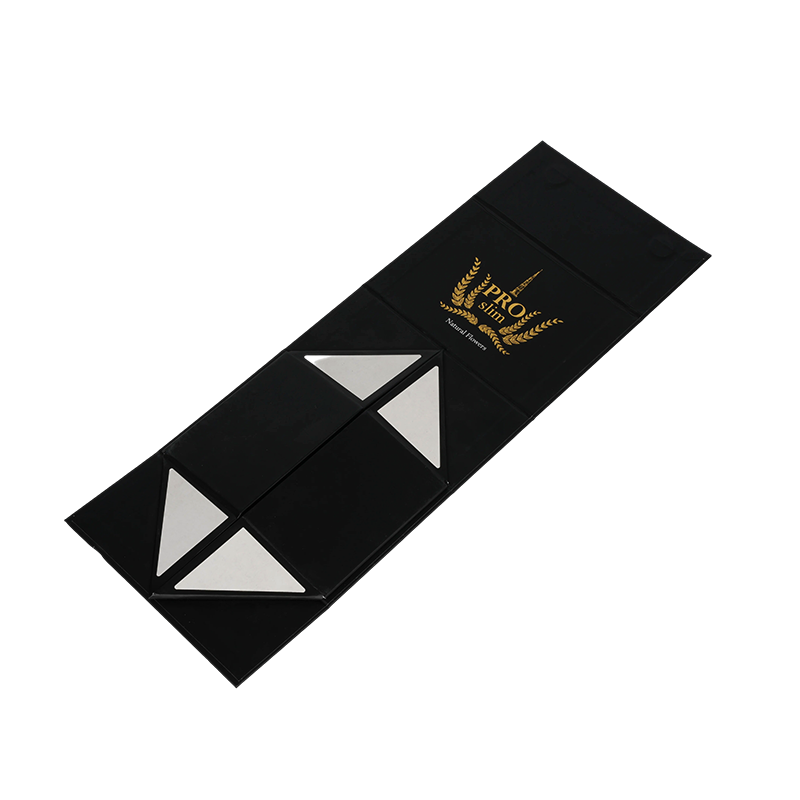 Foldable Matte Black Gift Box with Gold FoilTool-free lock-bottom assembly, flat storage and foil-stamped matte finish make this gift box relevant when reviewing die-cut creasing, blanking defects and repeatable folding.View Product →
Maintenance, Wear and Compliance Notes
A steel rule die is a consumable. Cutting rules typically hold up for 50,000 to 150,000 impressions on paperboard before re-rubbering or replacement; creasing rules retire sooner because they absorb compression on every cycle. A die run past that point still produces blanks that look correct on the pallet and fold badly on the customer's line.
Counter plates move as well. Patching a worn matrix with tape mid-run is normal practice; ignoring it is not. Board stored at 65% relative humidity gains caliper, which makes every crease in the die slightly too shallow — the same sheet that folded well in January can crack in July if storage is uncontrolled.
Three documents matter more than the die itself: an ISO 9001 certificate covering the quality system, a food-contact declaration for the board and any adhesive used, and a written statement on migration limits wherever the packaging touches food. Ask for them before the first production run, and keep the batch references with the die number so a complaint can be traced back to a specific tool and a specific press session.
Before you approve a die cutting operation, ask three questions: what is the crease spec, what is the print-to-cut tolerance, and how many sheets did the make-ready consume. Clear answers turn price per thousand into a fair comparison rather than a gamble. You can send a dieline and a board sample for a die review before committing to tooling.
Product Categories
Mainly engaged in various types of packaging boxes made of different materials and various paper products.







-
Email
[email protected]Phone Number
+86-15300896380 -
Address
No. 58 Hongmudan Road, Songjiang District, Shanghai, China -
Quick Links
Home About Us Service Industries News Contact -
Products
Food Packaging Cosmetic Packaging Gift Wrapping Apparel Packaging Home Textile Packaging Other Packaging Paper Packaging Boxes -
feel free to contact us

