
 English
 日本語
 Français
 Español
 عربى
 italiano


Industry News
 Oct 20, 2026
 Posted by Administrator
The Die Cut Process Explained: Methods, Tolerances and Packaging Costs
A 350 gsm print sheet does not become a folding carton until a steel rule strikes it. Every tab, slot, crease, nick and window in that blank is a decision made at the die stage, and those decisions come back later as gluer jams, cracked folds along the crease, or six percent scrap on a 50,000-piece run. Buyers who understand the die cut process early tend to argue about structure drawings instead of arguing about rejects.
The practical answer first: the die, not the machine catalogue, sets your tolerance, and the run length decides whether flatbed or rotary tooling pays for itself.
The short version
- The die is part of the product definition. Cut lines, crease lines, nicks and waste bridges all live in one plywood form.
- Flatbed handles rigid board, corrugated and short-to-medium runs; rotary wins on thin stock at volume.
- Realistic trim tolerance on sheet-fed carton work is about ±0.3 to ±0.5 mm, not the ±0.1 mm some spec sheets imply.
- Tooling is a one-time cost per design. Below roughly 5,000 pieces it usually outweighs every other cost line in the quote.
Content
- 1 What the Die Cut Process Physically Does to a Sheet
- 2 From Artwork to Finished Blank: Five Steps
- 3 Flatbed vs Rotary: Which Method Fits Your Run
- 4 The Cost Lines Nobody Shows You
- 5 Where Die Cutting Sits in Packaging Output
- 6 A Short Checklist Before You Approve Tooling
- 7 Die Care, Storage and Compliance
What the Die Cut Process Physically Does to a Sheet
A die is a plywood form, usually 18 to 20 mm thick, into which a laser burns the shape of every cut and crease. Steel rule is bent to match those channels and pressed in so the cutting edge stands a few millimetres proud of the wood. When the platen closes, the sheet is trapped between rule and a steel plate; where a cutting rule meets the plate the board is severed, and where a crease rule meets a channel in the counter plate the board is compressed instead of cut.
Cutting rule
Typically 2 pt or 3 pt steel at about 23.8 mm height. It severs the sheet everywhere except at nicks, small unsharpened gaps of 0.5 to 1.5 mm that hold the blank inside the sheet until it is broken out.
Creasing rule
Sits lower than the cut rule by roughly the board caliper and presses into a matrix about twice the caliper wide. A matched matrix folds cleanly; a channel that is too tight cracks the coated surface along the fold.
Ejection rubber
Compressible rubber beside the rule kicks the board back off the die after each impression. Once it hardens, blanks hang on the rule and the next sheet feeds into a jam.
After cutting, the waste skeleton is stripped, either by pins built into the tool or by a separate blanking station, and the nicks are broken so blanks release without tearing. A window is added at the same stage when the tool carries a windowing station, which is why windowed structures need to be confirmed before the die is made rather than after.
 Iridescent Die-Cut Skincare Box with Laser-Cut WindowThis flat-packed iridescent skincare carton uses a custom laser-cut window, making window shape a tooling decision to settle before die production.View Product →
Laser-cut windows on a rigid skincare box are a good example: the window outline and the crease pattern sit in one tool, so a change to the window means a change to the die.
From Artwork to Finished Blank: Five Steps
Structure and die line
A 1:1 die line separates cut, crease, perforation and window layers. Check tab clearance of 0.5 to 1 mm and a glue flap of at least 12 mm, or the gluer will fold the carton crooked regardless of how well it was cut.
Die making
Laser-cut plywood, rule bending, nicking and countersinking. Two to four working days is normal, and a revision after approval restarts the clock.
Make-ready
Lock-up, pressure adjustment and register to the printed sheet. Expect 50 to 150 sheets consumed, and inspect crease depth on the first twenty because crease problems surface long before cut problems do.
Running
First-off approval, then a pull every 500 to 1,000 sheets. Watch for broken nicks, which let blanks fall out, and for hangers caused by tired rubber.
Stripping and finishing
Waste removal, windowing, gluing, and any hand assembly such as ribbon or magnet insertion. This is where a blank that was cut to tolerance becomes a shippable box.
Flatbed vs Rotary: Which Method Fits Your Run
Both methods use the same principle, but the tooling economics differ sharply. Flatbed presses a flat sheet against a flat die; rotary wraps the die around a cylinder and either feeds a web or a sheet. Flatbed holds registration better on heavy or pre-printed board, rotary produces more units per hour on thin stock.
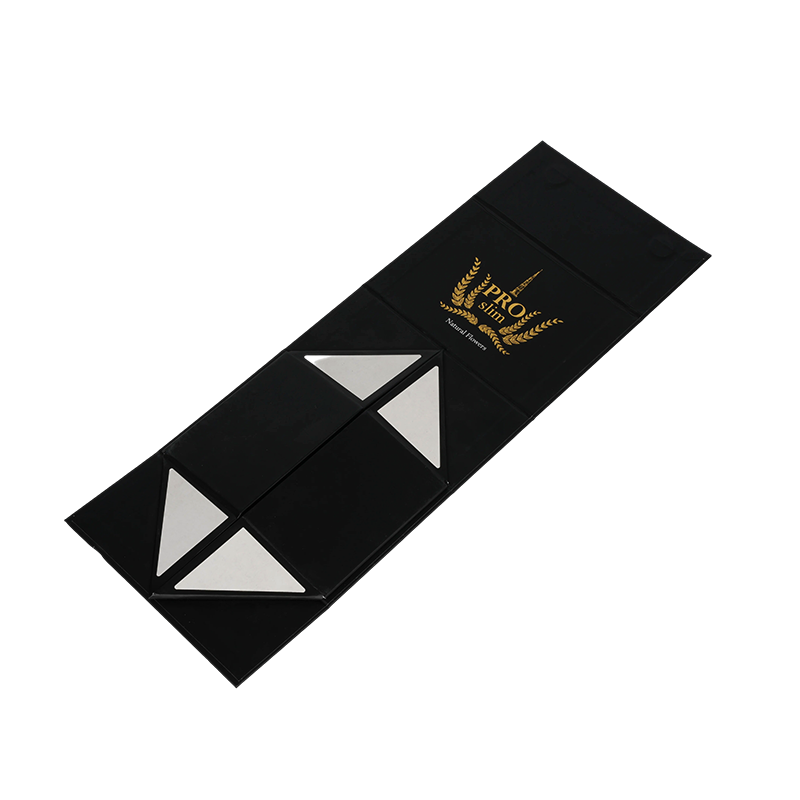 Foldable Lock-Bottom Gift Box with Gold Foil StampingA flat-pack lock-bottom gift box with matte black finish and gold foil; its interlocking tabs rely on precise crease and cut registration.View Product →
A lock-bottom gift box is a useful reference point: its four corner locks only engage reliably when the die holds crease position and cut length together, which is squarely flatbed territory at runs in the low thousands.
The Cost Lines Nobody Shows You
Ask three suppliers for the same 5,000-piece carton and the spread usually comes from tooling and make-ready, not from board price. At that volume, the die and the setup dominate the unit cost; push the same order to 40,000 pieces and the picture inverts almost completely.
Two other numbers rarely appear in a quote. First, die life: a steel rule die on 350 gsm board typically holds up for 100,000 to 300,000 impressions before re-ruling, and re-ruling costs roughly a third of a new tool. Second, tolerance creep: a worn crease matrix widens the fold line by a fraction of a millimetre, which is enough to make an auto-bottom carton pop open on a filling line. Neither is a defect you can see on a sample; both show up two weeks into production.
Where Die Cutting Sits in Packaging Output
Die-cut volume clusters where a blank must ship flat and erect quickly by hand or machine. Food and beverage cartons still take the largest share because they combine high volume with tight registration on printed board; beauty and personal care follow, driven by windowed and rigid structures that need clean edges.
The bag and label slice is often overlooked, yet it is where die cutting does quiet structural work: a reinforced die-cut handle on a kraft carrier bag has to survive a full load without tearing the top edge, and that performance is decided by the shape of the cut and the radius at the end of each handle slot rather than by the paper weight alone.
A Short Checklist Before You Approve Tooling
Approving a die is a one-way decision in practice. Run through these points before the tool goes to the laser, because each one is cheaper to fix on screen than on plywood.
- Confirm grain direction against the main fold. Folding across the grain on 400 gsm board is the single most common cause of cracked spines.
- Ask for a white sample of the exact structure, unglued, so you can feel the crease before decoration is approved.
- Check that the die line states board caliper, crease matrix width and nick positions, not just an outline.
- Agree who owns the tool, where it is stored and how many impressions it has already run if it is being reused.
- Set an AQL for crease cracking and nick tearing separately from print defects; they fail for different reasons.
 Foldable Fruit Gift Box with Window and Honeycomb InsertA corrugated fruit gift box with octagonal window, honeycomb insert and integrated handle; handle, window and insert are cut in one die pass.View Product →
Foldable honeycomb and integrated-handle fruit boxes are a good test case for this checklist: the handle, the window and the honeycomb insert are cut in one pass, so any change to one element re-cuts all three. If you are comparing structures for an upcoming season, it is worth sending the die line and target volume to the converting team before the artwork is finalised.
Die Care, Storage and Compliance
Keeping the tool honest
Store dies flat in a rack, not leaning, at 45 to 55 percent relative humidity; plywood that swells and dries loses its registration. Label each die with the design code, board caliper and impression count. Inspect rubber and nicks every 20,000 impressions, and check the crease matrix for polishing, which silently changes fold quality before any visible defect appears.
What buyers ask about
For food contact, the relevant framework is EU 1935/2004 with GMP Regulation 2023/2006, or FDA 21 CFR for the US market. Note that a die cut exposes fresh fibre along every cut edge, so migration testing should cover the cut edge and not only the printed surface. Lubricants used on the die and stripping pins should be food-grade where the pack touches product. Paper-based chain of custody under FSC or PEFC, and process control under ISO 9001, are the supporting documents most retail buyers request alongside the specification.
On a well-run line, the die cut process is invisible: blanks arrive flat, fold square, and glue without adjustment. When it is invisible, the tool was specified correctly. When it is not, the argument almost always traces back to a decision made on the die line.
Product Categories
Mainly engaged in various types of packaging boxes made of different materials and various paper products.








-
Email
[email protected]Phone Number
+86-15300896380 -
Address
No. 58 Hongmudan Road, Songjiang District, Shanghai, China -
Quick Links
Home About Us Service Industries News Contact -
Products
Food Packaging Cosmetic Packaging Gift Wrapping Apparel Packaging Home Textile Packaging Other Packaging Paper Packaging Boxes -
feel free to contact us

