
 English
  日本語
日本語  Français
  Español
  عربى
عربى  italiano

Industry News
 May 26, 2026
 Posted by Administrator
Hexagonal Gift Box: Design, Construction & Selection Guide
Content
- 1 What Sets the Hexagonal Gift Box Apart from Conventional Shapes
- 2 Construction Methods: Rigid vs. Folding Hexagon Boxes
- 3 Surface Finishing Options for Hexagonal Gift Boxes
- 4 Best Products to Package in a Hexagonal Gift Box
- 5 Custom Sizing and Insert Design for a Secure Fit
- 6 Evaluating a Hexagonal Gift Box Supplier: Key Questions to Ask
What Sets the Hexagonal Gift Box Apart from Conventional Shapes
Walk into any gift shop or premium food retailer and the packaging that draws attention first is almost never square. The eye moves toward what is unexpected — and the hexagonal gift box delivers exactly that kind of visual interruption. Its six equal sides create a silhouette that reads as distinctive without being eccentric, geometric without being cold. Against a shelf of rectangular boxes, a hexagon stops the eye before the product label even registers.
The differentiation is not purely aesthetic. The hexagonal form distributes structural load more evenly across its faces than a rectangle does at its corners — which are inherently the weakest points of conventional box construction. This means a well-made hexagonal gift box often provides better protection for its contents with equivalent or lighter board weight. For food gifting applications where product integrity during transit matters — mooncakes, chocolates, artisan foods — that structural characteristic has practical value beyond the visual.
There is also a behavioral dimension. Consumers engage physically with unusual shapes. A hexagonal box invites rotation — people pick it up, turn it, examine each face. That additional handling time extends product engagement and, in retail contexts, increases the likelihood of purchase. In gifting contexts, it prolongs the unboxing experience and gives the recipient more surface area to appreciate before even opening the box.
Construction Methods: Rigid vs. Folding Hexagon Boxes
Hexagonal gift boxes are produced by two fundamentally different manufacturing methods, each suited to different applications and budgets. Understanding the distinction is the first decision point for any buyer.
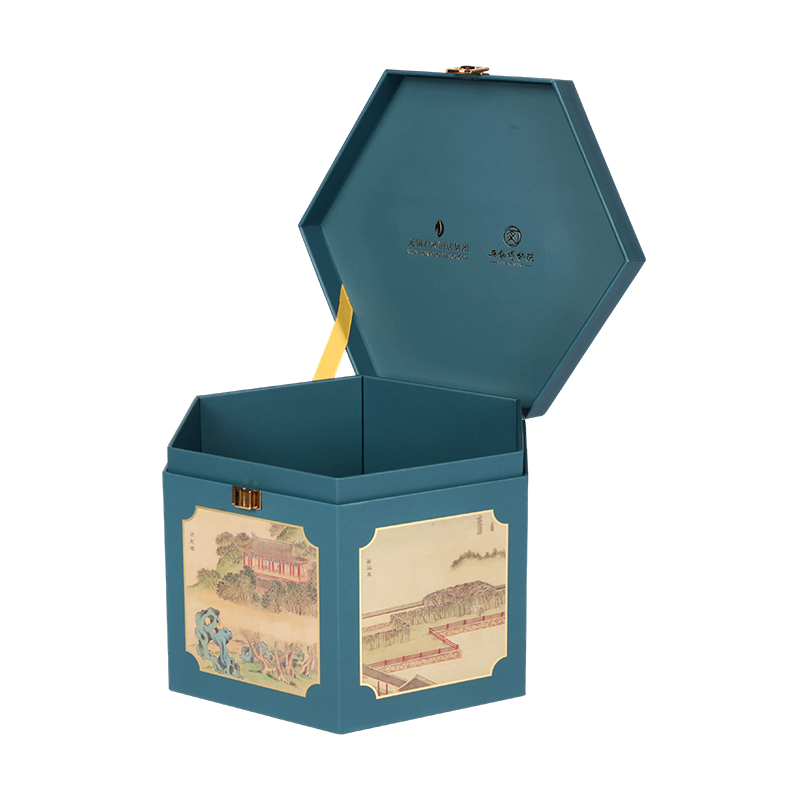
Rigid hexagonal gift boxes — also called set-up boxes or hardcover boxes — are constructed by wrapping a pre-cut greyboard shell in decorative paper using the lamination method. The greyboard provides the structural backbone; the wrapping paper carries the surface design. The result is a non-collapsible box that arrives at the retailer or recipient fully formed, ready to use. Rigid hexagonal boxes are the appropriate choice for premium gifting applications: luxury food collections, festival gift sets, corporate presentations, and any context where the box itself is part of the gift. They ship at volume without collapsing, stack cleanly, and hold their shape on shelf. The trade-off is cost — both per-unit and in minimum order quantity — and storage volume, since they cannot be flat-packed.
Folding carton hexagonal boxes are die-cut from a single sheet of paperboard, scored, and shipped flat for assembly at destination. They are significantly more cost-effective per unit and more storage-efficient, making them practical for higher-volume, lower-price-point applications: retail food packaging, seasonal promotions, bakery gifting. The limitation is structural — folding carton hexagons are lighter and less rigid, which affects perceived quality and limits the weight of product they can support without insert reinforcement.
For luxury food gift packaging, the rigid construction is typically non-negotiable. The board weight, the surface finish, and the solid feel of a rigid box are precisely the cues that communicate premium quality to the recipient.
Surface Finishing Options for Hexagonal Gift Boxes
The six faces of a hexagonal gift box offer more surface area for design expression than the four faces of a standard rectangle — and each face presents a distinct opportunity for visual storytelling, pattern continuation, or branding. The finishing choices applied to that surface determine how the box reads in the hand and in photographs.
Base lamination sets the visual register for the entire box:
- Matte lamination produces deep, absorbed color and a quiet, sophisticated surface. The dominant choice for luxury and festival food gifting where restraint signals quality.
- Gloss lamination maximizes color vibrancy and produces a reflective finish. Better suited to festive or children's gifting contexts where brightness is appropriate.
- Soft-touch lamination creates a velvety resistance to the finger — a tactile premium that photographs cannot capture but recipients immediately notice. Increasingly specified for high-end confectionery and tea packaging.
Decorative treatments applied over the base lamination add the differentiation that justifies a premium positioning:
- Hot foil stamping on the hexagonal faces creates a metallic accent that catches light differently as the box is rotated — an effect that standard flat packaging cannot replicate. Gold foil on a matte navy ground is among the most frequently specified combinations for Chinese festival food packaging.
- Embossing raises pattern elements, borders, or logos from the surface, adding a three-dimensional quality that the six-sided form amplifies — each face presenting the embossed element from a slightly different angle.
- Spot UV applied selectively over a matte ground creates high-contrast zones that direct the eye to key design elements without covering the entire surface.
Best Products to Package in a Hexagonal Gift Box
The hexagonal gift box is unusually versatile in terms of the products it accommodates — but some categories are a particularly strong match for its geometry and positioning.
Festival foods are the most natural fit. Dragon Boat Festival zongzi, Mid-Autumn Festival mooncakes, and Lunar New Year confectionery all benefit from the ceremonial presence a hexagonal rigid box provides. The shape echoes classical Chinese decorative geometry and conveys a sense of occasion that standard rectangular packaging does not. A well-designed hexagonal zongzi box with individual compartments for four to six pieces creates a gifting format that recipients retain and reuse long after the food is consumed — extending brand visibility and justifying a higher price point. Premium Christmas gift box packaging follows a similar logic for Western markets, where the hexagonal form reads as distinctive and considered rather than generic.
Specialty food collections — artisan chocolates, premium teas, gourmet honey, specialty coffee — are also well-matched to hexagonal packaging. The six-panel surface allows individual compartment labeling or a continuous pattern that wraps around the entire box, both of which are harder to achieve on a four-sided format. Luxury food and candy packaging in hexagonal formats consistently achieves higher perceived value scores than equivalent product in rectangular boxes across consumer research.
Beyond food, hexagonal rigid boxes are widely used for candles, jewelry sets, cosmetic gift collections, and small decorative objects — any product category where the packaging is expected to persist in the recipient's environment after the initial gifting occasion.
Custom Sizing and Insert Design for a Secure Fit
A hexagonal gift box that arrives with product shifting inside it has failed its primary function, regardless of how beautiful the exterior is. Insert design is the component that most buyers underestimate in the specification process — and the one that most directly determines whether the product arrives in the condition it was packed.
For food applications, insert options include:
- Molded pulp trays — custom-formed to hold specific product shapes, food-safe, and increasingly preferred for sustainability credentials. Well-suited to irregular food shapes like zongzi or individual pastries.
- Card dividers and paper trays — die-cut from board and assembled to create individual compartments within the hexagonal footprint. Cost-effective and customizable, but require precise engineering to maintain position within a non-rectangular base.
- EVA foam inserts — cut to shape and covered in fabric or paper, providing cushioning for fragile food items like chocolate truffles or glass-jarred products. Higher cost, but appropriate for top-tier luxury food gifting where product protection and presentation are equally weighted.
Custom sizing for hexagonal boxes requires providing the supplier with the precise inscribed circle diameter — the diameter of the largest circle that fits inside the hexagon — rather than a face-to-face measurement. This is the most reliable way to specify the usable internal footprint and ensure that product dimensions are checked against the correct geometry before tooling is confirmed.
Evaluating a Hexagonal Gift Box Supplier: Key Questions to Ask
Hexagonal gift boxes require more specialized tooling and technical capability than standard rectangular formats. Not every packaging supplier can produce them to a consistent standard, particularly at the board weights and finishing specifications required for luxury applications. Before committing to a production run, the following questions help identify suppliers with genuine capability versus those offering the format speculatively.
- Can you provide samples of current hexagonal rigid box production? — Samples from actual production runs reveal corner sharpness, board consistency, lamination adhesion, and finish quality far more reliably than renders or photographs.
- What is your minimum order quantity for a custom hexagonal format? — Custom die-cutting for non-standard shapes typically requires higher MOQs to recover tooling costs. Suppliers offering low MOQs on custom hexagonal rigid boxes without a tooling charge warrant additional scrutiny.
- What is your sampling lead time, and how many revision rounds are included? — For hexagonal boxes with custom inserts, a first-sample-to-approval cycle of 3–4 weeks is realistic. Faster timelines on complex formats may mean corners are being cut.
- What certifications do you hold for food-contact materials? — If any internal component will contact food directly, food-grade material documentation is required. Confirm this before sampling, not after.
Suppliers who engage thoughtfully with these questions — rather than redirecting immediately to price — are demonstrating the technical engagement that custom hexagonal gift box production actually demands. General gift packaging solutions from a qualified supplier should come with clear documentation, structured sampling, and proactive communication throughout the production process.
Product Categories
Mainly engaged in various types of packaging boxes made of different materials and various paper products.


-
Email
[email protected]Phone Number
+86-15300896380 -
Address
No. 58 Hongmudan Road, Songjiang District, Shanghai, China -
Quick Links
Home About Us Service Industries News Contact -
Products
Food Packaging Cosmetic Packaging Gift Wrapping Apparel Packaging Home Textile Packaging Other Packaging Paper Packaging Boxes -
feel free to contact us

