
 English
  日本語
日本語  Français
  Español
  عربى
عربى  italiano

Industry News
 Jul 22, 2026
 Posted by Administrator
Neo-Chinese Lid & Base Gift Box: Premium Rigid Packaging with Soft-Touch Finish
Content
- 1 Why the Neo-Chinese Lid & Base Gift Box Commands Premium Shelf Presence
- 2 Greyboard Core Selection: The Hidden Determinant of Box Longevity
- 3 Soft-Touch Matte Lamination: Material Science and Sensory Engineering
- 4 Color Specification and Print Reproduction for the Neo-Chinese Palette
- 5 Structural Design Variables: Lid Depth, Base Depth, and Overhang Ratios
- 6 Sustainability Considerations: Recyclability and Material Reduction in Rigid Gift Boxes
- 7 Quality Control Checkpoints for Consistent Production of Neo-Chinese Lid & Base Gift Boxes
Why the Neo-Chinese Lid & Base Gift Box Commands Premium Shelf Presence
The Neo-Chinese lid & base gift box achieves its distinctive market position through a deliberate material and construction hierarchy: a shallow celadon-toned lid sits atop a deeper mint-green base, both formed from 1,200–1,500 gsm greyboard laminated with coated art paper and finished in soft-touch matte lamination, delivering structural rigidity above 18 N/mm² edge crush resistance alongside a fingerprint-resistant, suede-like tactile surface that signals artisanal quality at the moment of unboxing. Unlike folding carton alternatives that rely on single-paperboard substrates and lose dimensional stability above 300 gsm, the two-piece rigid construction separates the structural function (greyboard core) from the aesthetic function (face paper + lamination), allowing each layer to be optimized independently. The lid overhang depth is typically engineered at 25–35 mm for boxes in the 200–300 mm face dimension range, creating a visual "reveal" when lifted—a design cue borrowed from traditional Chinese nested box architecture where the inner container emerges as a secondary gift. The contrasting two-tone colorway (pale celadon lid / mint green base) is not merely decorative; it references the Song-dynasty ceramic tradition where celadon glaze symbolized refinement and restraint, while the mint undertone introduces contemporary freshness that prevents the aesthetic from reading as museum-piece antiquarianism.
The Engineering Behind Flush-Fit Tolerances and Opening Resistance
Precision in a Neo-Chinese lid & base gift box is measured in tenths of a millimeter. The greyboard core is die-cut with a tolerance of ±0.3 mm on all four sides, then wrapped in face paper that adds 0.2–0.4 mm per surface depending on grammage. The resulting lid-to-base gap must be held to 0.8–1.2 mm on each edge—tight enough to prevent dust ingress and maintain visual crispness, yet loose enough to allow finger insertion for lifting without prying. Achieving this consistently requires greyboard with a moisture content stabilized at 6–8% before cutting; boards above 10% moisture swell during lamination and contract in dry storage, causing gap variation of ±0.5 mm that renders the fit either too loose (lid rattles) or too tight (vacuum lock). The opening resistance—the force required to separate lid from base—is calibrated through a combination of greyboard caliper (typically 1.5 mm for lids, 2.0 mm for bases in mid-size formats) and the coefficient of friction between the matte lamination films on opposing surfaces. A well-specified Neo-Chinese lid & base gift box exhibits an opening force of 2.5–4.0 N for a 250 mm × 180 mm footprint, producing the satisfying "pull and release" sensation that consumers associate with luxury unboxing without requiring excessive force that could damage delicate contents.
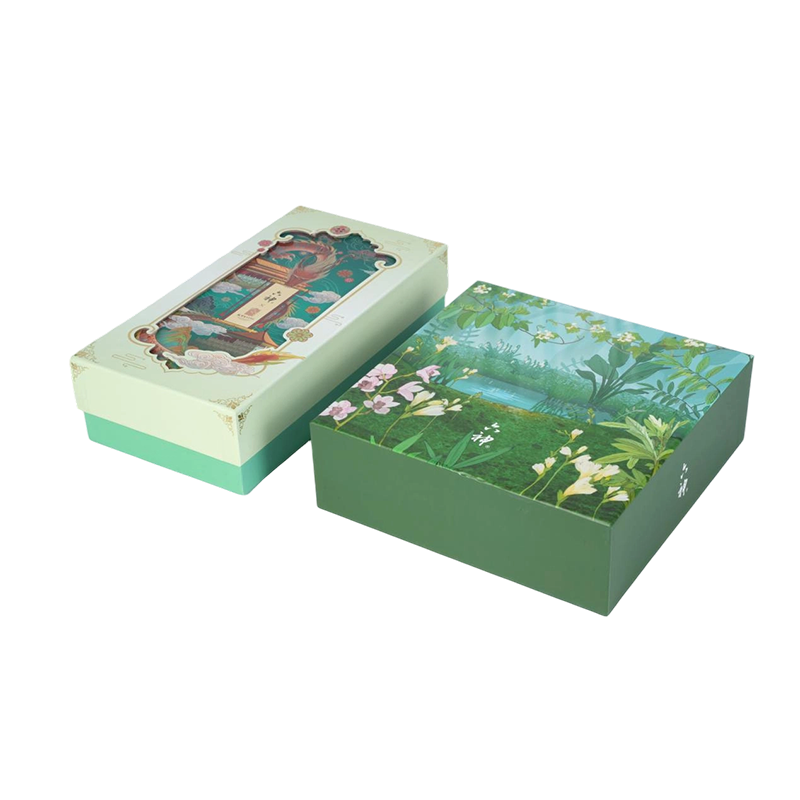
Greyboard Core Selection: The Hidden Determinant of Box Longevity
The greyboard core is the structural skeleton of every Neo-Chinese lid & base gift box, yet it is entirely invisible in the finished product. High-density greyboard—manufactured from 100% recycled paper pulp with a bulk density of 0.75–0.85 g/cm³—provides the compressive strength necessary to resist stacking loads in retail display and shipping environments. For gift boxes intended to hold contents weighing 500 g to 2 kg (typical for tea sets, silk scarves, or ceramic vessels), a minimum greyboard specification of 1,200 gsm (grams per square meter) is required to prevent base sag under load; for heavier items above 3 kg, 1,800–2,000 gsm greyboard or a composite honeycomb insert becomes necessary. The bending stiffness of 1,500 gsm greyboard measures approximately 12–15 N·m in the machine direction and 8–10 N·m cross-direction, providing sufficient rigidity that the box walls do not bow outward when the lid is removed and internal pressure from packing materials is released. Greyboard color matters too: while the face paper conceals the core on exterior surfaces, the raw edge visible at the lid-base junction should be neutral grey (L* 65–75 on the CIELAB scale) rather than brown or yellow, as off-tone edges compromise the perceived quality of the Neo-Chinese aesthetic where subtlety and finish consistency are paramount.
Moisture Management and Dimensional Stability in Varying Climates
Paper-based packaging is hygroscopic, and the Neo-Chinese lid & base gift box is no exception. Greyboard absorbs moisture from ambient air at a rate of approximately 1% weight gain per 10% RH increase, causing linear expansion of 0.1–0.15% per dimension. In humid climates (RH > 70%), an unprotected box can swell by 0.5 mm on a 200 mm side, converting a precise 1.0 mm lid gap into a tight 0.5 mm interference fit that makes opening difficult. Conversely, in dry winter climates (RH < 30%), desiccation causes greyboard shrinkage that increases gaps to 1.5–2.0 mm, creating a sloppy appearance and reducing dust protection. Manufacturers address this through controlled storage (RH 50–60%, 20–22°C) and by specifying face papers with low moisture vapor transmission rates. The soft-touch matte lamination film—typically a 25–30 μm BOPP or PET layer with an EVA hot-melt adhesive—acts as a moisture barrier, reducing water vapor transmission to 5–8 g/m²/day compared to 30–50 g/m²/day for unlaminated coated paper. For export shipments to tropical markets, silica gel desiccant packs (5 g per liter of internal volume) are recommended inside the box cavity to maintain equilibrium moisture content below 10% during ocean transit where container RH can exceed 85%.
Soft-Touch Matte Lamination: Material Science and Sensory Engineering
The soft-touch matte lamination is the defining tactile signature of the Neo-Chinese lid & base gift box, transforming a conventional printed surface into a suede-like skin that invites prolonged handling. This finish is achieved through a micro-embossed BOPP or PET film with a surface roughness (Ra) of 2.5–4.0 μm—rough enough to scatter incident light and eliminate glare (gloss level 3–8 GU at 60°), yet smooth enough to prevent fiber snagging on silk or cashmere contents. The matte texture is created by a chemical matte lacquer applied to the film substrate before lamination, containing silica particles at 3–5% concentration that create a micro-irregular topography. Beyond aesthetics, this surface treatment provides functional benefits: the coefficient of friction against human skin measures 0.35–0.50 (kinetic), compared to 0.15–0.25 for high-gloss UV varnish, meaning the box resists slipping from grasped hands and feels warmer to the touch due to increased contact area. Fingerprint resistance is achieved through a fluorinated topcoat at 0.5–1.0 g/m² that reduces surface energy to 22–26 dyn/cm, below the 30 dyn/cm threshold where sebum and skin oils spread into visible smudges.
Scratch Resistance and Durability Under Retail Handling Conditions
Retail environments subject packaging to abrasive contact with shelving, shopping bags, and other products. The soft-touch matte lamination on a Neo-Chinese lid & base gift box achieves a pencil hardness rating of 2H–3H (ASTM D3363), meaning it resists scratching by fingernails and keys under moderate pressure. Taber abrasion testing (CS-17 wheel, 1,000 cycles, 1,000 g load) shows weight loss of 15–25 mg for matte lamination versus 40–60 mg for uncoated art paper, confirming that the film layer extends surface life by a factor of 2–3×. However, the matte finish is vulnerable to alcohol-based cleaners and hand sanitizers, which can dissolve the fluorinated topcoat and create permanent whitening or tackiness. For retail display in environments where sanitizer use is frequent (cosmetics counters, pharmacy gift sections), a polyurethane-based matte varnish alternative provides equivalent tactile properties with chemical resistance to 70% isopropanol, though at a 15–20% cost premium over standard BOPP lamination.
Color Specification and Print Reproduction for the Neo-Chinese Palette
The pale celadon and mint green colorway of the Neo-Chinese lid & base gift box is not arbitrary; it is rooted in a specific cultural and material logic. Celadon (青瓷色) in print terms translates to a CMYK build of approximately C:15 M:5 Y:20 K:5, producing a desaturated green-grey that reads as warm rather than clinical. Mint green for the base requires a slightly higher chroma: C:30 M:0 Y:25 K:10, creating enough contrast against the celadon lid to define the two-piece architecture without clashing. These colors must be specified in Pantone-coated references for brand consistency across production batches: celadon maps to Pantone 7534 C (with a 10% lightness adjustment), while mint green aligns with Pantone 7485 C. The coated art paper substrate—typically 128–157 gsm C2S (coated two sides)—must have a brightness of 90–95% ISO and an opacity above 95% to prevent the greyboard core from shadowing through light tints. Soft-touch matte lamination reduces color saturation by 5–8% and lightness by 3–5% compared to the raw print, so pre-press color management must compensate by boosting chroma 8–10% in the digital file before output. Delta-E color tolerance between production batches should be held below 2.0 (CIEDE2000) to ensure that a customer purchasing the same gift box six months apart perceives no visible shift.
Structural Design Variables: Lid Depth, Base Depth, and Overhang Ratios
The proportions of a Neo-Chinese lid & base gift box are governed by both aesthetic tradition and structural mechanics. The lid depth-to-base depth ratio typically falls between 1:3 and 1:4 for standard gift applications: a 60 mm deep lid over a 200 mm deep base creates a balanced silhouette that references classical Chinese nested food containers (提盒), while a 1:5 ratio (40 mm lid / 200 mm base) reads as more contemporary and minimalist. The lid overhang—the distance the lid extends beyond the base wall—ranges from 3 mm (flush contemporary) to 8 mm (traditional generous reveal), with 5 mm being the commercial sweet spot that accommodates manufacturing tolerance while providing finger purchase for lifting. For boxes exceeding 350 mm in any plan dimension, the lid overhang must increase to 8–10 mm to prevent the lid from binding on the base due to cumulative tolerance stack-up across the long edge. The table below summarizes recommended proportions by box size and intended content category.
| Plan Dimension (mm) | Lid Depth (mm) | Base Depth (mm) | Overhang (mm) | Typical Content |
|---|---|---|---|---|
| 150 × 100 | 25 | 80 | 3–4 | Jewelry, tea sachets |
| 200 × 150 | 40 | 120 | 5 | Silk scarves, cosmetics sets |
| 250 × 180 | 50 | 160 | 5–6 | Tea sets, ceramic vessels |
| 300 × 220 | 60 | 200 | 6–8 | Wine bottles, gift hampers |
| 350 × 250 | 70 | 240 | 8–10 | Multiple-item luxury sets |
Sustainability Considerations: Recyclability and Material Reduction in Rigid Gift Boxes
The environmental profile of a Neo-Chinese lid & base gift box is determined by material choices at three layers: the greyboard core (recyclable and typically 100% post-consumer recycled content), the coated art paper face (recyclable if unlaminated, but the soft-touch matte BOPP film complicates repulping), and the hot-melt adhesive bonding system. The BOPP lamination film constitutes only 3–5% of total box weight, but its presence requires separation before paper recycling—a process that not all municipal facilities support. Forward-looking manufacturers are transitioning to cellulose-based matte films (cellulose diacetate or NatureFlex™) that biodegrade in industrial composting environments and do not interfere with paper recycling streams, though these materials cost 40–60% more than BOPP and offer slightly lower scratch resistance (pencil hardness 1H–2H versus 2H–3H). Another sustainability lever is material reduction: optimizing the greyboard caliper through finite element analysis can reduce core weight by 10–15% without compromising stacking strength, and specifying lighter face papers (128 gsm versus 157 gsm) saves approximately 8–10% in paper consumption per thousand boxes. For brands positioning in the sustainable luxury segment, these incremental changes—combined with soy-based inks and water-based lamination adhesives—allow the Neo-Chinese lid & base gift box to carry FSC® certification and meet the packaging recyclability thresholds required by the EU Packaging and Packaging Waste Regulation (PPWR).
Quality Control Checkpoints for Consistent Production of Neo-Chinese Lid & Base Gift Boxes
Mass production of rigid gift boxes requires disciplined process control to maintain the tight tolerances that define the Neo-Chinese aesthetic. Critical checkpoints include:
- Greyboard incoming inspection: Caliper measured at five points per sheet must fall within ±0.05 mm of specification; moisture content verified by capacitance meter at 6–8% before cutting.
- Die-cutting accuracy: First-article inspection on a coordinate measuring machine (CMM) confirms all four sides within ±0.3 mm and corner squareness within 0.2°.
- Lamination bond strength: Peel test per ASTM D903 must exceed 1.5 N/cm for paper-to-greyboard and 0.8 N/cm for film-to-paper interfaces.
- Color verification: Spectrophotometer readings on every 500th box; Delta-E must remain below 2.0 against the master standard.
- Dimensional fit: Lid-to-base gap measured with feeler gauges at midpoints of all four sides; acceptable range 0.8–1.2 mm per edge.
- Surface quality: Visual inspection under 500 lux D65 lighting for scratches, bubbles, or lamination wrinkles; tactile verification for consistent suede feel across the batch.
These controls ensure that the Neo-Chinese lid & base gift box delivers the same unboxing experience whether produced in a run of 500 units for a boutique tea brand or 50,000 units for a national cosmetics retailer.
Product Categories
Mainly engaged in various types of packaging boxes made of different materials and various paper products.


-
Email
[email protected]Phone Number
+86-15300896380 -
Address
No. 58 Hongmudan Road, Songjiang District, Shanghai, China -
Quick Links
Home About Us Service Industries News Contact -
Products
Food Packaging Cosmetic Packaging Gift Wrapping Apparel Packaging Home Textile Packaging Other Packaging Paper Packaging Boxes -
feel free to contact us

